Awaken Your Soul: Daily Bible Fire, Prayers That Move Mountains & Christian Gear That Roars Faith!
Beyond Sourdough: 3 Biblical Food Preservation Methods
Learn how to preserve food off-grid using ancient oil-submersion, lactic-fermentation, and ash-curing. Zero electricity or modern gear required!
David Hess
7/14/20268 min read


Beyond Sourdough: 3 Forgotten Biblical Methods for Long-Term Food Preservation
Reclaiming the Lost Heritage of Food Security, Sovereignty, and Analog Survival
By The Faithful Patriot Editorial Team | July 2026
The 2026 Sovereignty Shift: In an era defined by supply chain fragility, whispers of digital currency control, and a steady march away from natural self-reliance, the modern homesteader is searching for something deeper than basic preparedness. While the "sourdough craze" reintroduced millions to the beauty of wild fermentation, it only scratched the surface of historical self-sufficiency. To truly insulate your home and "Joseph-proof" your pantry, we must look further back—to the highly sophisticated, low-technology preservation strategies developed by our biblical ancestors.
The modern grocery store is a monument to fragile complexity. It operates on a "just-in-time" delivery model, meaning that if the digital grid, transportation networks, or fuel pipelines falter for even forty-eight hours, the shelves empty completely. For decades, the globalist system has trained us to trade our self-reliance for convenience, turning us into consumers who are entirely dependent on a highly centralized, easily controlled distribution network.
But the Christian Patriot does not live by the rules of panic. We live by the rules of stewardship, foresight, and dominion.
Long before the invention of the electric refrigerator, the pressure canner, or the vacuum sealer, our spiritual ancestors lived, thrived, and preserved massive agricultural surpluses in the harsh, semi-arid climate of the Levant. They didn't have access to Mylar bags, oxygen absorbers, or deep freezers. Yet, they managed to store grains for years, preserve dairy through scorching desert summers, and keep summer fruits sweet and nutritious long into the winter months.
In this comprehensive guide, we are going to bypass the shallow, modern trends and rediscover three forgotten biblical food preservation methods. These are not merely historical curiosities; they are low-cost, high-yield, analog survival technologies that you can implement in your home, backyard, or homestead today.
Method 1: The Joseph Principle of "Anoxic" Underground Grain Storage
When we read the story of Joseph in Genesis 41, we tend to view the seven years of abundant harvests and seven years of famine as a miraculous event—which it was, spiritually. But the practical execution of saving an entire empire from starvation required an incredible mastery of engineering and physical science.
Genesis 41:48 tells us:
"So he gathered all the food of the seven years which were in the land of Egypt, and laid up the food in the cities; he laid up in every city the food of the fields which surrounded them."
How did Joseph store millions of bushels of wheat and barley for seven years without it rotting, being consumed by weevils, or being destroyed by mold?
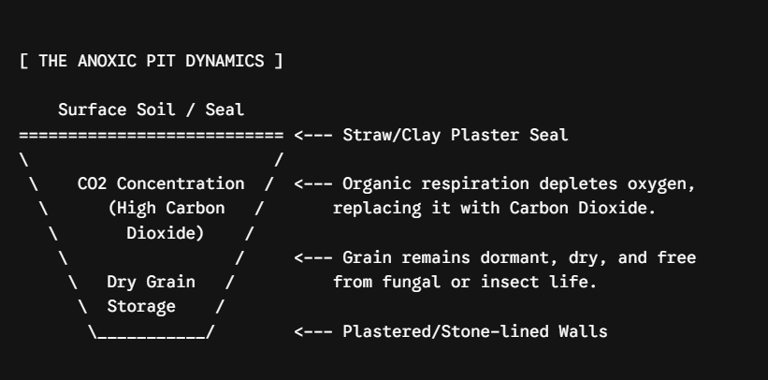
The secret lies in a method known to archaeologists as anoxic underground pit storage.
The Science of Anoxia
When grain is harvested, it is still technically alive. The individual kernels undergo a very slow process of cellular respiration, consuming tiny amounts of oxygen ($O_2$) and releasing carbon dioxide ($CO_2$) and moisture.
If you store grain in a standard, open bin, oxygen is constantly replenished, which allows fungal spores, mold, and insect pests (like the destructive grain weevil) to thrive and devour the crop.
The ancient Israelites and Egyptians solved this by digging large, subterranean, bell-shaped pits directly into the dry earth or bedrock. They lined these pits with stone, plastered them with lime or clay to prevent underground moisture from seeping in, filled them to the brim with dry grain, and sealed the top opening with a thick plug of clay and straw.
Within days of sealing the pit, the natural respiration of the grain (and any tiny insects present) consumed all the remaining oxygen inside the sealed chamber. Because the pit was airtight, no new oxygen could enter. The environment became anoxic (devoid of oxygen).
Without oxygen, all adult insects, larvae, and eggs suffocated and died.
Fungal spores could not germinate or spread.
The grain entered a state of deep dormancy, preserving its nutritional value and even its germination viability for years.
How to Implement the Joseph Principle Today
You do not need to dig a massive pit in your suburban backyard to use this principle. You can replicate anoxic storage using simple, modern, non-electric materials:
The Food-Grade Drum Method: Obtain clean, 55-gallon food-grade plastic or steel drums with gasket-sealed, clamp-on lids. Ensure your grain (wheatberries, oats, barley, or rice) is thoroughly dry—ideally below 10% moisture content.
The Dry Ice Trick: To rapidly induce an anoxic state without waiting for natural respiration, place a small block of dry ice (solid carbon dioxide) wrapped in a paper towel at the bottom of the drum before filling it with grain. As the dry ice sublimates, the heavy $CO_2$ gas will rise, pushing the lighter, oxygen-rich air out of the top of the drum. Once the dry ice is fully vaporized, clamp the gasket lid tightly.
Storage Location: Keep the sealed drums in a cool, dark, temperature-stable environment, such as a root cellar, basement, or crawl space. Done correctly, your grain will remain pristine and perfectly edible for decades.
Method 2: Lacto-Fermenting and "Dehydrating" Dairy into Samnah and Kishk
The Land of Promise is famously described throughout the Old Testament as "a land flowing with milk and honey" (Exodus 3:8). However, fresh milk from sheep and goats spoils within hours in the intense heat of the Middle East. To make use of their abundant dairy, the ancient Hebrews had to develop highly ingenious processing methods to transform highly perishable milk into stable, long-term survival rations.
While modern homesteaders are familiar with hard cheeses, two other ancient dairy preservation methods are far more resilient, requiring zero refrigeration and lasting for months or even years: Samnah (clarified preservation butter) and Kishk (fermented grain-dairy stones).
1. Samnah (Anhydrous Butterfat / Ghee)
Fresh butter contains about 16-18% water and small amounts of milk solids (proteins and sugars). It is this water and protein content that allows bacteria to grow, causing butter to go rancid quickly at room temperature.
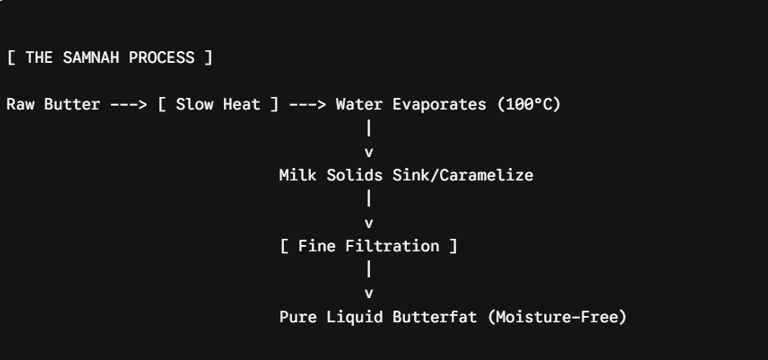
The biblical solution was to boil the butter down to remove every trace of moisture, a process known as producing clarified butter or Samnah.
By gently simmering butter, the water content completely evaporates, and the milk proteins clump together and sink to the bottom of the vessel. Once strained through fine linen, you are left with pure, golden, anhydrous (water-free) butterfat.
Without moisture or protein, bacteria cannot survive. Ancient families stored Samnah in clay jars, often sealed with a layer of olive oil on top to prevent contact with air. It could sit on a dark pantry shelf for over a year without losing its flavor or nutritional density.
2. Kishk (The Ancient "MRE")
If you want the ultimate biblical survival food, look no further than Kishk. Developed by nomadic pastoralists in the ancient Near East, Kishk is a brilliant combination of dairy preservation and grain stabilization.
It is made by mixing highly acidic, fermented yogurt (which contains natural preservative lactic acid) with parched, cracked wheat (bulgur). The wheat absorbs the yogurt over several days of fermentation, souring the grain and infusing it with beneficial probiotics and lactic acid.
Once the fermentation is complete, the mixture is formed into small, flat stones or balls and dried thoroughly in the blazing sun.
The Result: A rock-hard, bone-dry, highly acidic, protein-rich ration.
Shelf Life: Indefinite. Kishk can be kept in simple cloth bags for years.
How to Eat It: To reconstitute, you simply grind the dried Kishk stones into a powder and whisk it into hot water, olive oil, and garlic to create a rich, incredibly nourishing, and savory porridge.
Method 3: Sun-Cured Fruit Cakes (Debelah and Tsimmuq)
In the agrarian cycle of ancient Israel, summer brought a massive explosion of sweet, perishable fruits: grapes, figs, dates, and pomegranates. Since these fruits ripened all at once, eating them fresh was impossible before rot set in.
To preserve these precious calories and concentrated sugars for the lean winter months and long military campaigns, the Israelites turned to sun-curing and pressing fruits into dense, durable, transportable cakes.
The Bible references these energy-dense survival foods frequently:
Debelah (Pressed Fig Cakes): Mentioned in 1 Samuel 30:12, where a starving Egyptian slave is revived with "a piece of a cake of figs."
Tsimmuq (Raisin Cakes): In 1 Samuel 25:18, Abigail quickly gathers "a hundred clusters of raisins" to appease David's army.
The Power of Osmotic Pressure
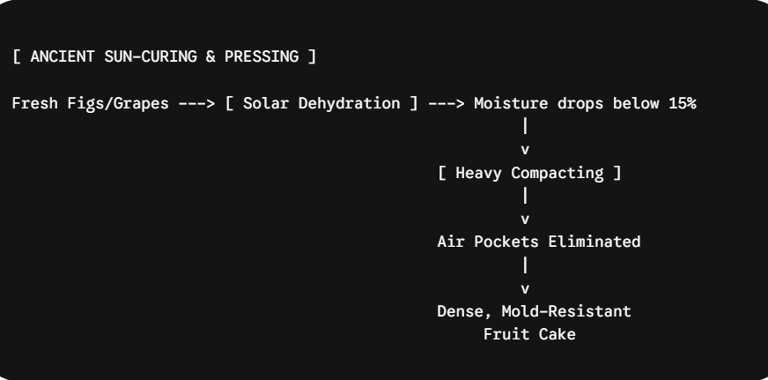
Dehydration works by reducing the "water activity" ($a_w$) of food. When the moisture content of a fig or grape drops below a certain threshold (typically under 15-20%), the concentration of natural sugars becomes so high that it exerts massive osmotic pressure on any invading microbes.
If a mold spore or bacterium lands on a highly concentrated sugar surface, the sugar draws moisture out of the microbe's cell walls through osmosis, dehydrating and killing the organism.
By pressing these dried fruits tightly into compressed cakes (Debelah), the ancient Israelites eliminated air pockets where moisture could condense, creating an extremely shelf-stable, mold-resistant block of high-density energy.
Reclaiming Sun-Cured Cakes on the Homestead
You do not need an expensive electric dehydrator running up your utility bill to preserve fruit like a biblical watchman:
Solar Dehydration: Construct a simple solar dehydrator using a wooden frame, food-safe wire mesh screen, and a sheet of glass or clear plastic. Place fresh, halved figs, plums, or seedless grapes on the screen. The glass traps heat, while ventilation holes allow moisture-laden air to escape, rapidly drying the fruit using the power of the sun.
The Pressing Process: Once the fruit is leather-dry but still pliable, pack it tightly into a wooden mold or clean bread tin lined with parchment paper. Apply heavy pressure using a clean brick or a hand press to compress the fruit into a solid block.
Storage: Wrap the pressed cakes in butcher paper or store them in stone crocks in a cool, dry place. These cakes will provide your family with an instant source of natural sugars, vitamins, and minerals throughout the winter, completely independent of the commercial food supply.
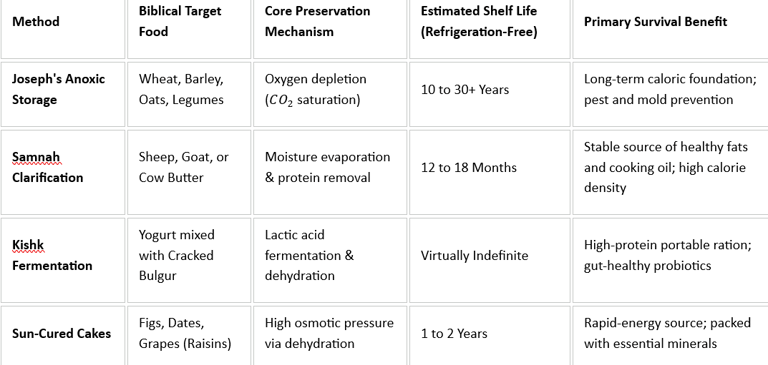
The Master Comparison of Preservation Methods
To help you decide how to integrate these biblical strategies into your family’s preparedness plan, we have compiled a quick-reference guide highlighting the inputs, shelf life, and primary survival benefits of each method:
Reclaiming the Legacy of Self-Reliance
The globalist push toward a centralized, digital, and synthetic food system is designed to create a dependent populace. When a family relies on the state or global corporations for their next meal, they are incredibly vulnerable to coercion.
But when you understand how to harness the simple, elegant laws of biology and physics that God built into creation, you break those chains of dependence.
By reclaiming these forgotten biblical preservation methods, you are doing more than just stocking shelves; you are practicing the biblical mandate of dominion. You are stepping out of the brittle, fragile digital age and anchoring your family in the time-tested, resilient ways of the Faithful Patriot.
Stand firm. Build your storehouses. Keep your trust in the Provider of the Harvest.
Digging Deeper into Biblical Preservation
For a fascinating visual demonstration of how ancient grains were stored to survive massive famines, watch this detailed study on How Ancient Israelites Stored Grain for 7 Years. This video breaks down the specific physics of underground anoxic storage that kept nations alive during historic crises.
Contact
Connect
faithfulpatriot@faithfulpatriot.us
© 2025. All rights reserved.